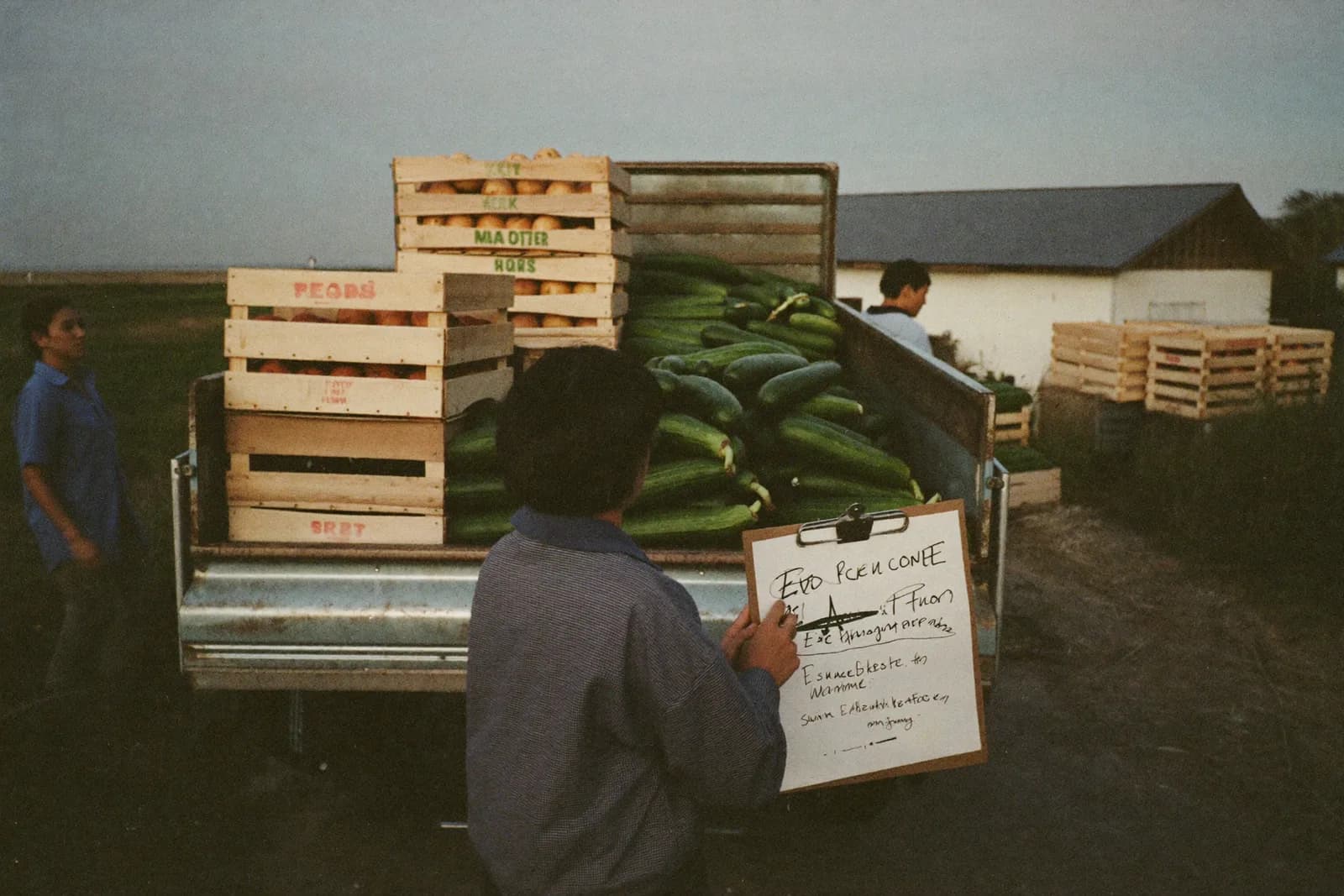
At 4:50 on a Thursday morning, in a yard outside Harlow Ridge, a man named Errol is arguing with a phone. The phone has told him to collect from the Vance farm before the Dunmore farm, which is wrong, because the Vance gate is chained until six and everyone within thirty miles knows it. Errol taps a button that says “gate’s shut.” The route reorders. He drives.
Two hundred miles away, Maya Okonjo sees the tap land. She has been awake since four because that is when the routes go out, and because Fieldnote — the company she founded four years ago — has two employees, and one of them is her.
The problem is a spreadsheet named after someone’s wife
Before Fieldnote, the Harlow Ridge Growers’ Co-operative routed forty farms with a spreadsheet called SANDRA.xlsx. It was named after an office manager who left in 2016 and who was, for the eight years after that, the only person who had ever fully understood it. Every co-op Okonjo visits has a SANDRA. The names change. The spreadsheets are not stupid — they encode real knowledge. The Vance gate. The bridge that floods. The farm whose driveway a full-size truck cannot turn in. The grower who won’t answer a phone before seven but will answer a knock. Off-the-shelf routing software throws all of that away on day one and produces a mathematically optimal route that a driver ignores by 5:15.
Every routing product I’ve seen treats local knowledge as noise. It’s not noise. It’s the entire product. The mileage is the easy part.
Fieldnote’s design decision is that the driver is right. When Errol says the gate is shut, the system doesn’t argue and doesn’t escalate to anyone. It reroutes, records the constraint, and never suggests that order again. Okonjo calls this “letting the truck teach the map.” Her engineer, Sam Devlin, calls it “a very expensive way of writing down what Errol already knew,” which Okonjo says is exactly correct and the reason it works.
Two people, on purpose
Fieldnote serves 60 co-ops, covering somewhere near 2,000 farms. It bills the co-op, not the farm — a flat subscription that scales with member count and lands between $400 and $2,600 a month. Revenue is a shade over $1.1M a year, and it has been profitable since month fourteen. It has two people. Okonjo says it will have two people in 2028.
This is not modesty and it is not a bootstrapping principle. It is a load-bearing product decision, and she explains it in operational terms. Fieldnote has no support team, so the software cannot generate support tickets, so it cannot ship anything confusing. It has no sales team, so it cannot sell to a co-op that will need hand-holding. It has no customer success function, so onboarding has to fit in one visit. “Headcount is how a product gets to be bad,” she said. “You hire five support people and now the software is allowed to be confusing, because someone’s job is to explain it. I can’t afford that, so it has to be obvious. The constraint does the design work I’m not good enough to do.” The things she has said no to, in order:
- A seed round in 2023 whose plan had eleven hires in it by month eighteen.
- A grocery chain that wanted a version for its own distribution — the same software, a customer with a procurement department.
- Live GPS tracking, requested by four co-ops, declined because the drivers did not request it.
- Anything that requires a farm to install anything. Fieldnote touches the co-op and the truck. Never the grower.
- An acquisition offer last spring, from a company Okonjo declined to name and described only as “a SANDRA the size of a building.”
What breaks
Okonjo is straightforward about the failure modes, having thought about them more than she would like. If she gets sick, routing does not stop — the system runs — but nothing gets fixed for a week. Devlin can hold it. Neither of them pretends this is a plan. The other thing that breaks is her calendar. Every new co-op means a visit, a visit means two days of driving, and sixty co-ops means a growth rate of one a month is also a decision about how many nights she spends in a Comfort Inn. She has settled on eight new co-ops a year. It is not a target derived from a market model. It is what fits.
The API opened to partners this month, which is the first thing Fieldnote has shipped that could plausibly grow without her in the truck. Okonjo is cautious about it in a way that suggests she has already imagined the support tickets. Back in Harlow Ridge, Errol reaches the Dunmore farm at 5:20. The Vance gate opens at six, as it always has. Somewhere in a database, that fact now exists in writing for the first time in forty years.