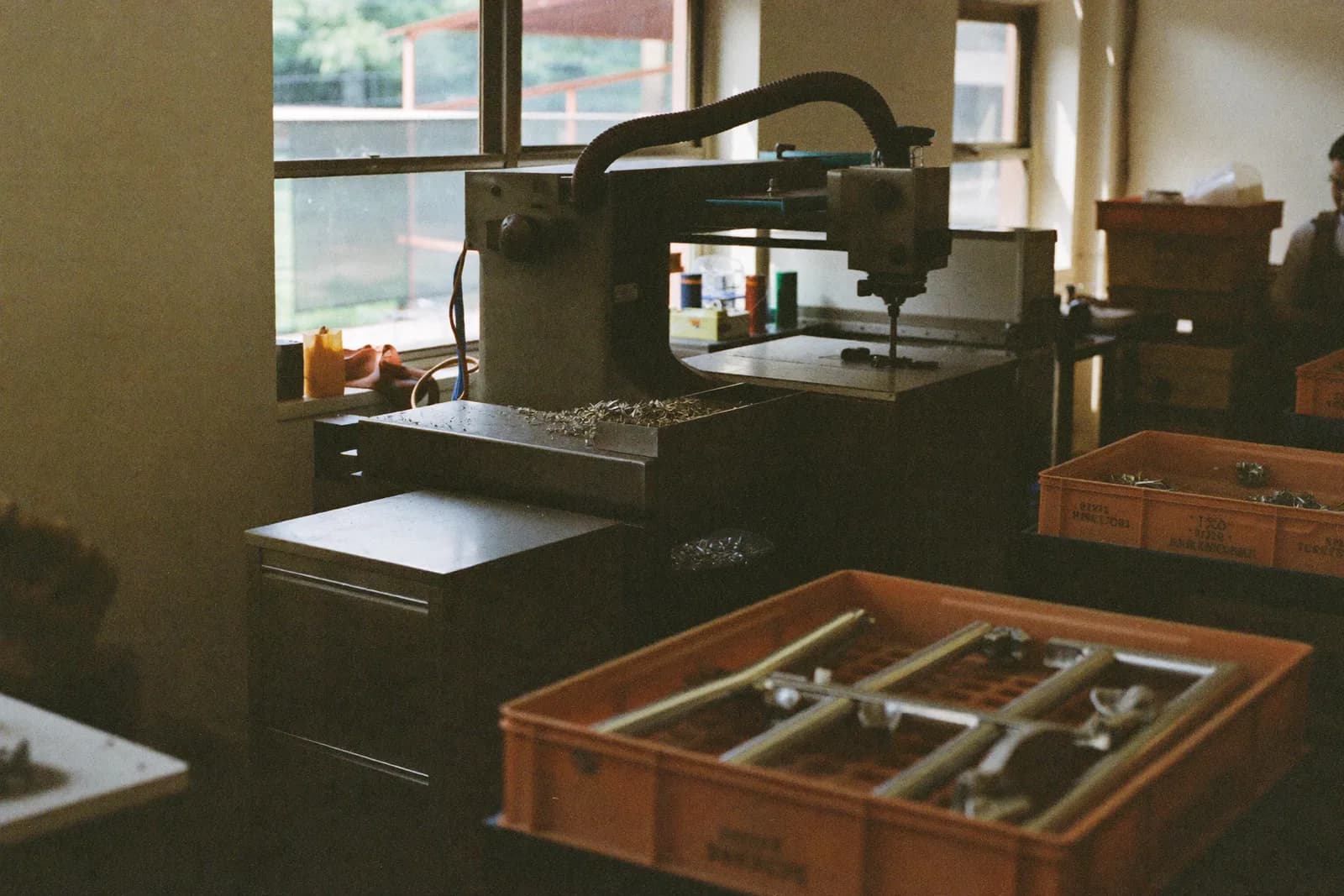
The building at 114 Delaney Street sold shoes for forty-one years, then nothing for six. It now contains four CNC routers, a spray booth, eleven people and a laminating press that had to be craned through the front window because the door was built for handbags. The window is still there. From the sidewalk you can watch someone edge-band a cabinet door. Halloway Cabinetry pays $3.40 a square foot for the privilege. The nearest industrial park, nine miles out, wanted $11.20 and a five-year term.
That gap is the whole story, and it is showing up in the permit data. The Sherwood Index, which tracks light-industrial use permits across 340 mid-size North American towns, recorded a 40% year-over-year rise in permits issued for manufacturing in previously retail-zoned space. The base is small — 2,100 permits, against 1,500 the year before. The direction is not ambiguous.
The math starts with an empty shopfront
Main Street retail emptied out over fifteen years and nobody has found a replacement tenant class that pays what a shoe store paid. Landlords who spent a decade holding out for another retailer have mostly stopped holding out. A workshop that signs a three-year lease and pays on time now looks like the best offer on the table, and it is being priced that way. The buildings turn out to be more suitable than anyone expected: old retail has ceiling height, a loading door somewhere, three-phase power left over from whatever was there in 1962, and a floor rated for stock. What it lacks is a zoning category, which is why the permits are the interesting number rather than the leases.
We didn’t rezone anything. We just stopped pretending a cabinet shop was a nuisance use because it had a saw in it.
Aldrich County issued nine such permits last year, up from one. Marsh says the ordinance change took eleven minutes at a council meeting and mostly involved deleting a paragraph written in 1974, when the thing planners were worried about was a tannery.
Freight did the rest
Cheap rent explains why the buildings are available. It doesn’t explain why anyone wants to make things in them. The second half of the answer is that the supply chain that made distance free stopped being free. The Sherwood Index puts average landed container cost on the transpacific lane at 2.4 times its 2019 level, and — the number operators actually care about — schedule variance at plus or minus eleven days. A cabinet company that quotes an eight-week lead time cannot absorb an eleven-day coin flip. So it stops trying. What comes back onshore is specific, and it is not commodity production, which still doesn’t work here and probably never will again. It is:
- Anything bulky relative to its value, where freight is a large share of cost — cabinetry, furniture, tanks, panels.
- Anything customized per order, where a container of identical units is useless.
- Anything with a short quote-to-delivery promise, where schedule variance eats the margin.
- Anything the customer wants to see before it ships, which turns out to include most things costing more than $4,000.
None of that describes a shipping container of chair legs. All of it describes a shop with eleven people in an old shoe store.
Hiring is the constraint, not demand
Every operator interviewed for this piece said a version of the same thing: they could sell more than they can make, and the reason they can’t make more is that they can’t staff more. The Main Street location helps here more than the rent does. A shop in an industrial park nine miles out draws from whoever owns a reliable car. A shop on Delaney Street draws from whoever can walk, and Halloway’s owner, Gene Halloway, says four of his eleven people applied because they saw the window. “I have never placed an ad,” he said. “I have a sign in the glass that says we train. That’s the entire recruiting function.” Training is where the honesty comes in. Halloway loses roughly a third of what he trains within two years, mostly to the industrial park, which pays more because it doesn’t train anyone. He described this as subsidizing his competitor’s HR department and then, unprompted, said he’d do it again, because the alternative is a shop where nobody knows anything and he cuts every door himself.
It is worth being clear about the size of the thing. Twenty-one hundred permits across 340 towns is roughly six shops per town per year. Nobody’s tax base is being rebuilt by this, and the Sherwood Index’s own note on the series says so, in a footnote that reads, in full: “Growth rate is high; base is not. Do not extrapolate.” But six shops per town is six that were zero a decade ago, in buildings that were going to stay empty, employing people who were going to keep commuting. The romance of it — the lit window, the visible work — is real and also mostly beside the point. Halloway took the building because it was $3.40 a foot. The window was free.