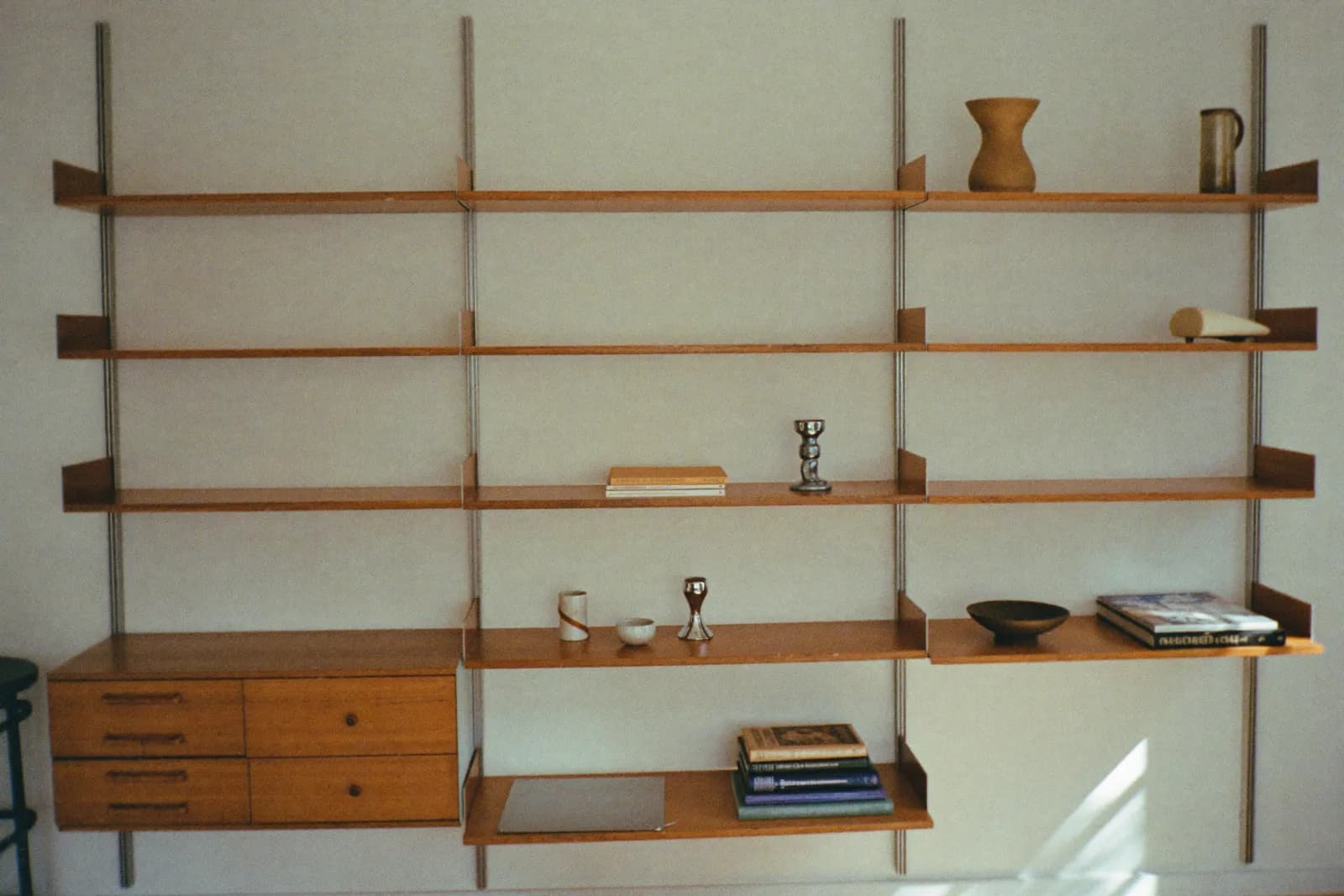
Most furniture companies measure themselves by how much they sell. Vitsœ, the British-German firm behind one of the most quietly influential objects in modern design, has spent its whole existence measuring itself by how little it needs to. For more than sixty years it has built and sold essentially the same product — a wall-mounted shelving system first drawn in 1960 — and treated the refusal to move faster than that as a matter of principle rather than a constraint.
The company began in 1959 in Frankfurt, where the Danish furniture dealer Niels Vitsœ and the German designer Otto Zapf founded Vitsœ + Zapf to manufacture the furniture of a young industrial designer named Dieter Rams — who was, at the same time, shaping the products of Braun. In 1960 they launched the 606 Universal Shelving System: aluminium tracks fixed to the wall, with cantilevered shelves and cabinets that clip on and move where they are needed. Rams was twenty-eight. The system is still made, still sold, and essentially unchanged.
Zapf left in 1969 and the company took the single name Vitsœ. What it kept was Rams’s way of thinking about design, later distilled into three words the firm still treats as its brief: “Less, but better.” Rams arrived at the phrase, as Vitsœ tells it, as a more succinct expression of his ten principles for good design. The 606 is what the phrase looks like as an object — and, for six decades, as a business.
Less, but better
In practice, that means a company built to sell you as little as it can get away with. Vitsœ sells direct rather than through retailers, does not discount, and designs the shelving so that a customer buys a small amount, adds to it over years, and takes it apart to move it rather than replacing it. The system that leaves the workshop is meant to outlast the room it goes into. For a company, that is a strange thing to optimise for: every design decision points away from the next sale.
Mark Adams, Vitsœ’s managing director — who rescued the company from financial difficulty in the 1990s and moved its production to Britain — states the purpose more plainly than most founders would dare. “Vitsœ’s purpose, as a company,” he told The Challenger Project, “is to allow more people to live better with less, that lasts longer.” It is a sentence engineered to sell fewer things, and he means it as a boast.
The short-term, thoughtless disposability of our world is clearly completely unsustainable, and we stand fundamentally and passionately against that.
The refusal to grow faster
The obvious ways to grow a furniture company are to widen the range, cut the price, and sell through everyone who will carry it. Vitsœ has declined all three for most of its life, and Adams frames the declining as the strategy rather than a cost of it. “Where possible,” he says, “we stand against the consumption of resources” — an unusual thing for a manufacturer to say about the thing it manufactures.
What makes the position hold is that the company is unembarrassed about who it is not for. A product that asks a customer to buy slowly and keep something for decades is not a mass product, and Vitsœ does not pretend otherwise. “We’ve got to be brave enough to take a position and stand by it,” Adams says. “Not everybody likes it. Vitsœ is not to everybody’s taste.” The clarity is the moat: a company certain of its narrow appeal does not need to chase the customers it was never going to keep.
That certainty is, by Adams’s own account, the point. “I am absolutely passionate about having a belief and sticking to that belief,” he says — which is, stripped of the design language, a description of the slow build itself. The discipline is not making better shelves each year. It is making the same good ones, and refusing every offer to make them faster, cheaper, or more.
A building to match the furniture
In 2017 the company did the most Vitsœ thing imaginable with its own premises: rather than rent flexible space it could grow out of, it built a permanent one. It moved its workshop and headquarters to a purpose-built production building in Royal Leamington Spa, in central England — made, fittingly, out of wood and glass, and designed to be added to over time in the same way the shelving is. A firm that sells longevity built itself a home on the same terms.
Sixty years is long enough for most of a company’s original bets to be proved wrong. Vitsœ’s central one — that there is a durable business in selling people less, and selling it to them for good — has instead become the fashionable position, as disposability turned from convenience into liability. The company did not get there by moving quickly. It got there by drawing one thing well in 1960 and having the patience, and the nerve, to still be making it.
Sources