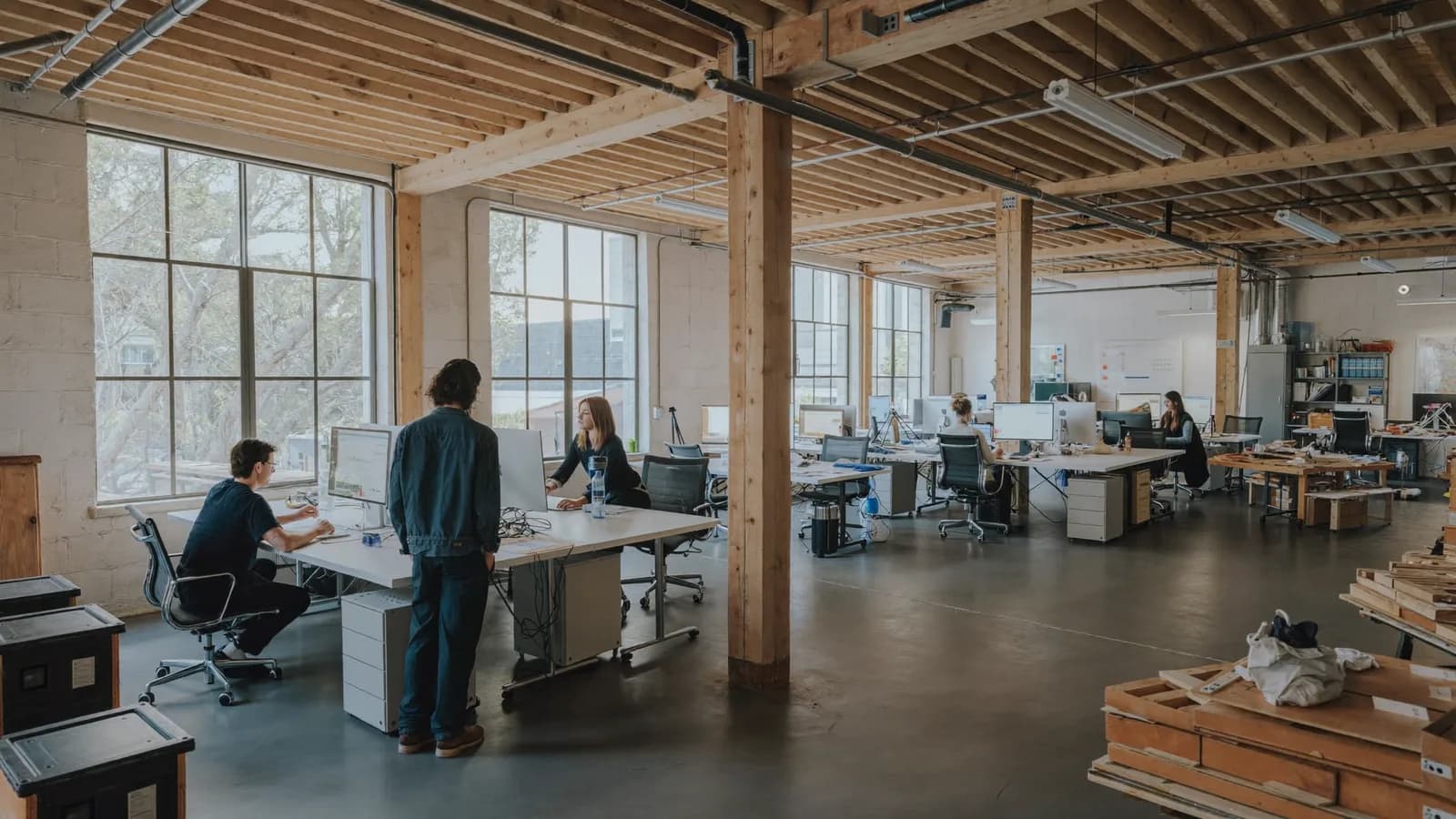
The kitchen at Trellis Diagnostics, a fourteen-person device company on the north edge of Ashfield, contains a chest freezer, a bread oven that cost more than any desk in the building, and a laminated sheet where staff sign up to cook. On Thursdays the whole company eats at one table at half past twelve. Thursday attendance is fourteen out of fourteen. Monday, when nobody cooks, runs closer to five.
Nobody at Trellis is required to be anywhere. Dana Reisz, who founded the company in 2021 after eleven years in contract manufacturing, has never written an attendance policy and says she has no intention of starting. Her view is that a commute is a bill her staff pay in time, and that the office either covers the bill or it doesn’t.
This is, quietly, where the return-to-office argument has landed for companies too small to have an HR function. The mandate fight was always a large-company fight — you need several thousand employees before you can afford to lose the goodwill. Founders with fourteen people can’t. So they bought ovens instead.
The commute is a bill
A survey by the Brackett Group of 940 companies under fifty staff put some numbers on it. Firms that introduced an attendance requirement saw in-office days rise about nine percentage points in the first quarter — and give back roughly two-thirds of that gain by the fourth, mostly through quiet non-compliance nobody wanted to police. Firms that spent money on the office instead saw a smaller first-quarter bump, around six points, and still held it a year later.
The spending is not extravagant. Brackett put the median at $61 per employee per week across food, equipment and space — call it $45,000 a year for a company of fourteen. That is less than the fully loaded cost of one junior hire, and considerably less than the cost of the two people who quietly leave after a mandate they didn’t agree to.
Reisz does the arithmetic differently. A cooked lunch at Trellis costs about $9 a head, which she compares not against payroll but against the forty minutes each way her staff spend getting to her building. “I’m buying back eighty minutes of someone’s life,” she said. “Nine dollars is an insulting price for that. It’s also the only offer I have.”
What people actually come in for
The founders doing this well have converged on a short list, and it is not the list the office-design industry sells. Nobody has mentioned a slide. In roughly two dozen conversations, four things came up repeatedly:
- Food that someone else made, eaten at a fixed time — the fixed time matters more than the food.
- Equipment that is better than what people own: a real monitor, a real chair, a bench with a vice on it.
- A room where talking is not allowed, which turns out to be the single most requested feature and the cheapest to build.
- A guarantee that the people you came in to see are also there — attendance clustered on two days beats attendance spread across five.
That third item catches founders off guard. The open plan was sold as collaboration, and collaboration is precisely what people can now do from a kitchen table. What they cannot do at home, if they have children or a housemate or a thin wall, is concentrate. Loom&Co, the textile company, put a door on a storage closet, added a lamp, and reports it is booked solid — a $400 renovation outperforming a lease renegotiation.
We stopped asking why people won’t come in. The honest question was what we were offering them when they did, and the honest answer was a chair and a wifi password.
There is an obvious objection: this is bribery. Reisz doesn’t argue with the word. She points out that the office was always a transaction — it was just one where the employer set the terms and the employee had no alternative venue. The alternative venue now exists, so the terms are being renegotiated, and the renegotiation costs about nine dollars.
The founders who are struggling are, almost without exception, the ones who kept the office they signed for in 2019 and expected it to do the work. It has a good address, an atrium, and no oven. On Thursdays, it is empty.