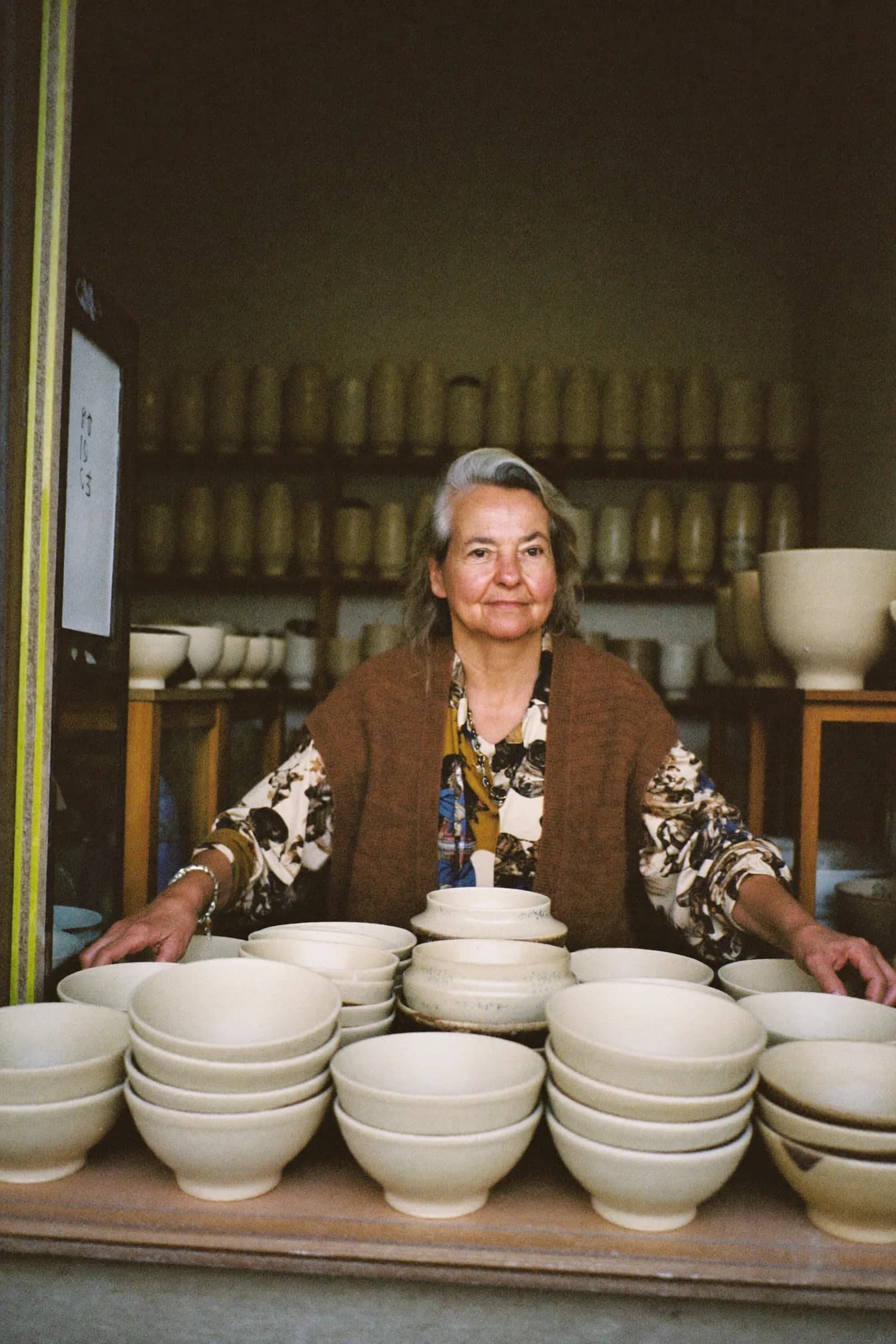
The wheel is in the window, which is the whole argument, though it took Della Marsh three years to be able to say so. It faces out. She throws at it on Tuesday and Thursday afternoons with her back to the street and a mirror angled so she can see who has stopped. On a good Thursday, eleven people stop. Four come in. She has never spoken to any of them first — the rule is that they speak first — and she says the rule is the only piece of retail strategy she has ever written down.
Marsh sells ceramics: bowls, mugs, a wide serving dish that accounts for more of her revenue than she thinks is dignified. She opened the shop in 2020, at the precise moment every person she asked told her not to.
“The advice was unanimous,” she says. “Not mixed. Unanimous. A lease is a liability, the internet is free, why would you pay for a room. And it was good advice. It was just answering a question about cost, and I had a question about strangers.”
The number that settled it
For eighteen months before the shop, Marsh sold online and did what you do: she bought advertising. She kept the receipts, which is why this conversation has numbers in it. In her last full year of online-only, she spent about $14,000 on ads and acquired 310 customers — roughly $45 each — at an average order of $68. The arithmetic worked, barely, in the way that a treadmill works. Stop paying and the strangers stop arriving, immediately and completely, which she discovered in a month when her card expired and nobody told her.
The shop is $2,100 a month. Call it $25,000 a year with the utilities and the insurance and the thing that happened to the boiler. In her second full year it produced 640 new customers who had never heard of her — the ones who stopped, not the ones who came looking. That is about $39 each, which is not a dramatic improvement, and Marsh says that if the story ended there it would not be a story.
The ad bought me a click. The window bought me a person who watched me make the thing for four minutes and then wanted it. Those are not the same customer and they never spend the same money.
What she means is the second half of the ledger. The ad customer spent $68 and returned 14% of the time. The shop customer spent $110 on first purchase and came back 41% of the time, and Marsh’s best guess at three-year value is something over $400 against something under $90. The rent, at that point, stops being a cost per customer and starts being the cheapest thing on her profit and loss.
What the room does that a page can’t
Her theory, offered reluctantly because she says she distrusts founders with theories, is that a photograph of a bowl is a claim and a bowl is a fact. The bowl is heavier than people expect. This is the single most common thing said out loud in her shop and she has stopped counting it. Nobody has ever said it about a photograph.
- Six years of Tuesdays and Thursdays at the wheel: about 620 afternoons, no advertising bought since 2021.
- Wholesale accounts: 4, all of which walked in off the street. None was pitched.
- Returns: 1.2%, against 9% in the online-only years. People do not return a thing they have held.
- The serving dish, her best product, which she made because a woman in the shop asked for something bigger and then, when Marsh said she didn’t make one, waited.
- Days the shop has been open and taken nothing at all: 31. She counts these too.
The commissions are the part that surprised her most. About 30% of her revenue now comes from work that did not exist until somebody stood in the room and described it, and Marsh is clear that none of those conversations could have started in an inbox, because none of the people who started them knew what they wanted before they were standing in front of the wrong thing. “A shop is a machine for being asked for something you don’t sell,” she says. “That’s not a service. That’s the product roadmap.”
The honest asterisk
She will not generalise it, and gets slightly sharp when pressed. The shop works because the making is watchable. Marsh points out that the same lease, occupied by someone assembling a product out of a box, would be a liability exactly as advertised, and that the advice she was given was not wrong so much as sound for a business she did not have. The Corrigan Institute’s work on independent retail puts the median small shop’s survival at four years, and Marsh does not think she has beaten that by being clever. She thinks she has an unusual product — one where the manufacture is the marketing, and the marketing happens to require a window.
The online store still exists. It does about a fifth of revenue and Marsh treats it as a receipt printer for people who already met her. Asked whether she would open a second shop, she says no with a speed that suggests she has been asked, and explains that the second one would need someone at the wheel in the window, and the only person she has is her. Then she turns back around, because someone has stopped.