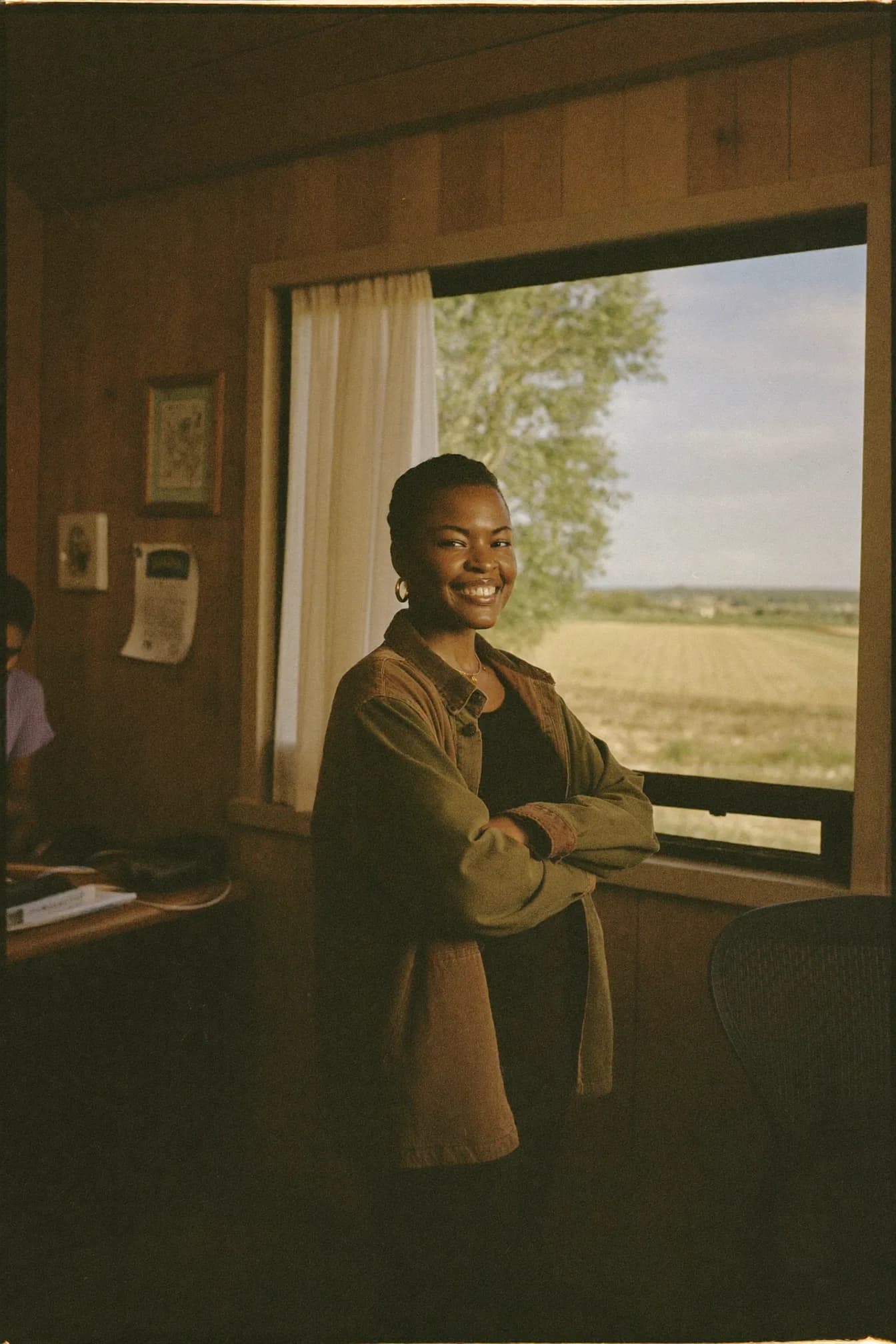
The Fieldnote office is a corner of the Harlow Ridge co-op building, with wood panelling from an era that believed in wood panelling and a window that frames 300 acres of stubble. Maya Okonjo did not choose it for the view. She chose it because the loading yard is forty feet away, and when the software is wrong, a man named Errol walks over and tells her within the hour.
Fieldnote routes produce collection — which farm a truck hits, in what order, and where the crates end up. It serves 60 co-ops and something near 2,000 farms. It is two people: Okonjo and an engineer named Sam Devlin. It has never raised money, has been profitable since month fourteen, and does a shade over $1.1 million a year.
The season in the truck
In 2021 Okonjo had a prototype, five years at a logistics company, and a growing suspicion that she was about to build something clever and useless. So she asked the Harlow Ridge manager whether she could ride along for the season. He said yes, she thinks, mostly because he assumed she would last a week.
She lasted the season: eleven weeks, six days a week, in the passenger seat, taking notes on a clipboard because a laptop was absurd at 4:50 in the morning and her phone was dead by two. She started the company the following year.
“Every wrong assumption I had, I had it out loud in a truck cab, next to somebody who could correct me,” she says. “That’s the cheapest correction available. It costs a thermos.”
What the clipboard caught
The prototype optimised for total miles, which is what the textbooks optimise for and what no driver has ever cared about. The list of things it did not know is long, and Okonjo can still recite it:
- The Vance gate is chained until six. Not a rule written anywhere — just a fact that everyone within thirty miles knows and no database contains.
- A driver will not take a route that puts him behind a tractor on a hill road, at any time saving, and will simply ignore the app.
- The loading queue is social. A driver who has been waiting will wave a friend ahead. The software cannot model this and should not try.
- Dust on a phone screen means the interface has about three taps in it, all of them big, before somebody gives up and uses the radio.
- Nobody knows the farm’s name. They know whose farm it was two owners ago.
“I could have shipped in March and spent three years finding out why nobody opened it. Instead I found out in October, from Errol, for free, while he ate a sandwich.”
The rewrite that followed was less clever than the prototype and far better. The design decision underneath it is that the driver is right: when Errol taps the button that says “gate’s shut,” Fieldnote does not argue, does not escalate, and does not ask him to justify it. It reorders the route, records the constraint, and never suggests that sequence again. Okonjo calls this letting the truck teach the map. Total miles went up 4%. The manager called her, unprompted, the following spring, to ask what it would cost to keep it.
Two people, on purpose
Fieldnote bills the co-op rather than the farm — a flat subscription that scales with member count, landing between $400 and $2,600 a month. Okonjo has been offered money four times and has hired nobody beyond Devlin. Her reasoning is less ideological than architectural, and it comes back to the yard forty feet away: the moment you have twelve people, somebody’s whole job is translating between the trucks and the code, and the translation is where the product dies.
She still rides two weeks a season. Devlin does one, which was a condition of the job and, he has said, the strangest line in an offer letter he has ever signed. Okonjo is unapologetic about it. “You can’t read your way to this,” she says. “You have to be in the cab when the thing goes wrong, and the driver looks at the phone, and then he looks at you.”