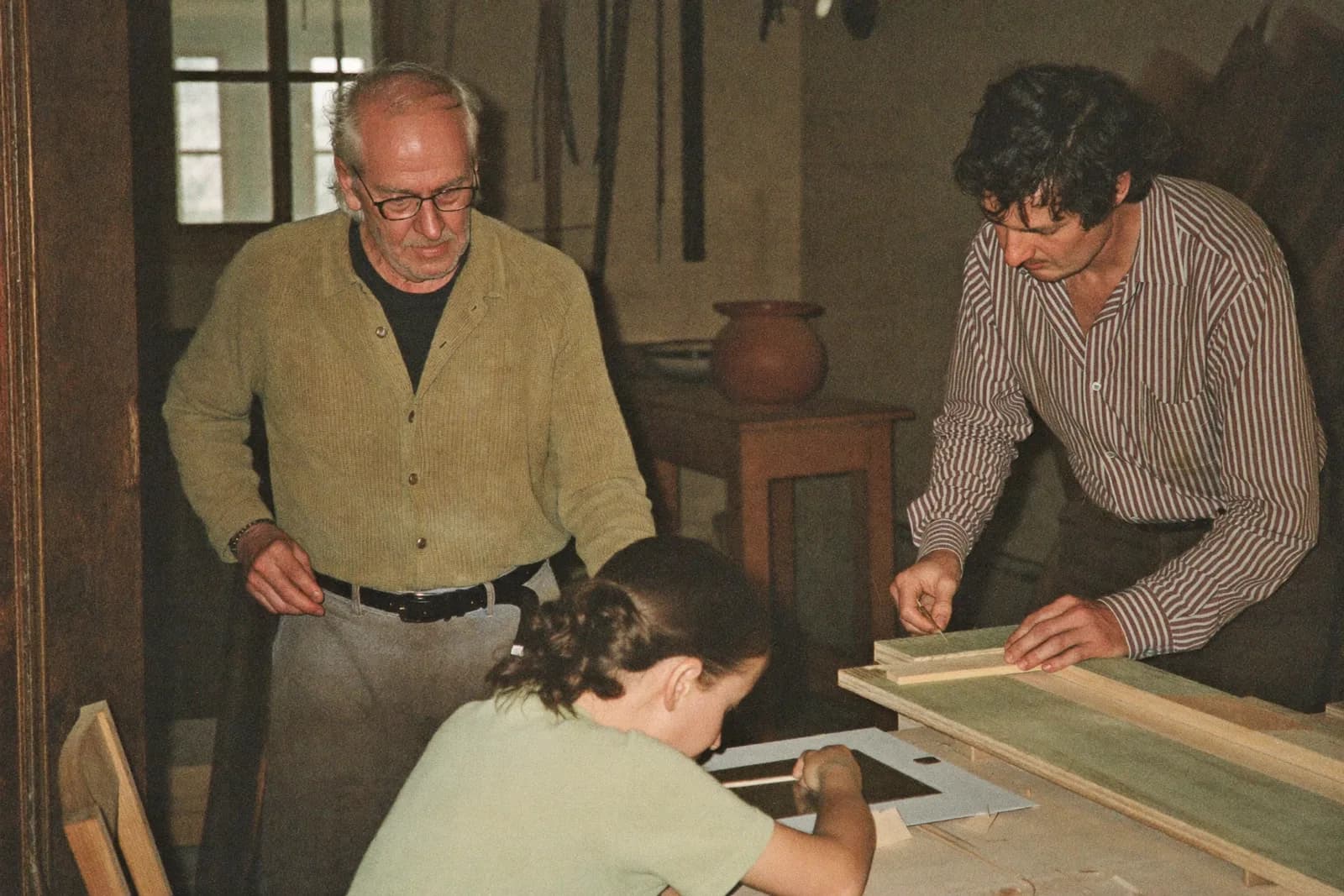
Walt Brenner still comes in on Thursdays. He is 74, he no longer owns any part of the building or the business inside it, and he stands at the end of the bench with his hands behind his back watching Eli Nakamura mark out a frame — a posture Nakamura describes, without heat, as “the worst thing that has ever happened to me and also the reason the joint is right.”
Brenner Woodwork has been making furniture in the same brick shop in Easthampton, Massachusetts since 1964. Brenner’s father started it; Brenner took it over in 1981; Nakamura bought it in March 2025 for $410,000, of which he had $46,000.
Two years before he cut anything
Nakamura arrived in 2016, 24 years old, with an architecture degree and, he says now, an unearned confidence that a degree is a kind of credit you can spend. Brenner had him sweeping, stacking, and taking apart the shop’s own furniture — pieces that had come back for repair after thirty years — for two years before he was permitted to make a cut on anything a customer would receive. “I thought he was hazing me,” Nakamura says. “He wasn’t. He was showing me the failures. You cannot learn what fails from a new piece. Everything new is perfect. Everything that comes back at thirty is honest.”
Brenner’s account is shorter. Asked why two years, he says: “Because it was two years.”
The conversation nobody scheduled
By 2023 the shop had seven employees and about $1.9 million in revenue, most of it built-in cabinetry for houses within ninety minutes. Brenner was 72 and had been approached twice — once by a private buyer who wanted the name and intended to move production to North Carolina, and once by a regional millwork firm that wanted the client list and had no view on the name at all. He turned both down without mentioning either to anyone, which Nakamura found out about a year later and still, mildly, resents.
“He’d spent seven years teaching me how the shop thinks. Selling it to somebody else would have been like teaching a kid the piano and then setting fire to the piano.”
The actual conversation happened in the parking lot in October 2023 and lasted, by both accounts, under five minutes. Brenner said he wanted to be done by 75 and asked whether Nakamura wanted it. Nakamura said yes, then said he had no money. Brenner said he knew that, and that it wasn’t the interesting part.
The interesting part
The structure took fourteen months and two lawyers to write down and is, stripped of the language, simple:
- $410,000, valued at roughly 2.5× the shop’s three-year average profit — a number Brenner arrived at himself and declined to negotiate.
- $46,000 down, all of Nakamura’s savings. Brenner financed the remaining $364,000 over nine years at 5%, payable monthly out of the business.
- Brenner stays on the note, not the cap table. He owns nothing and is owed $3,900 a month, which he says focuses the mind on whether he trained the boy properly.
- A Thursday clause, unwritten and non-negotiable, under which Brenner comes in and says nothing until he says one thing.
- The name stays. This was the only term Brenner raised twice.
Sixteen months in, Nakamura has made two payments late and both times called before the due date, which he says is the entire relationship in one habit. He has raised prices 18%, dropped the two builders who paid at ninety days, and hired an apprentice named Rosa who has now been sweeping for eleven months and has cut nothing. She has asked about this. He has told her it will be two years.
Brenner, on his way out on a Thursday, offers the only assessment he seems willing to make. “He’s better than me at the drawings,” he says, putting on his coat. “Slower on the machines. He’ll be fine.” Then, at the door, the one thing: the reveal on the frame is a sixteenth proud. Nakamura had already seen it. He says he had already seen it.