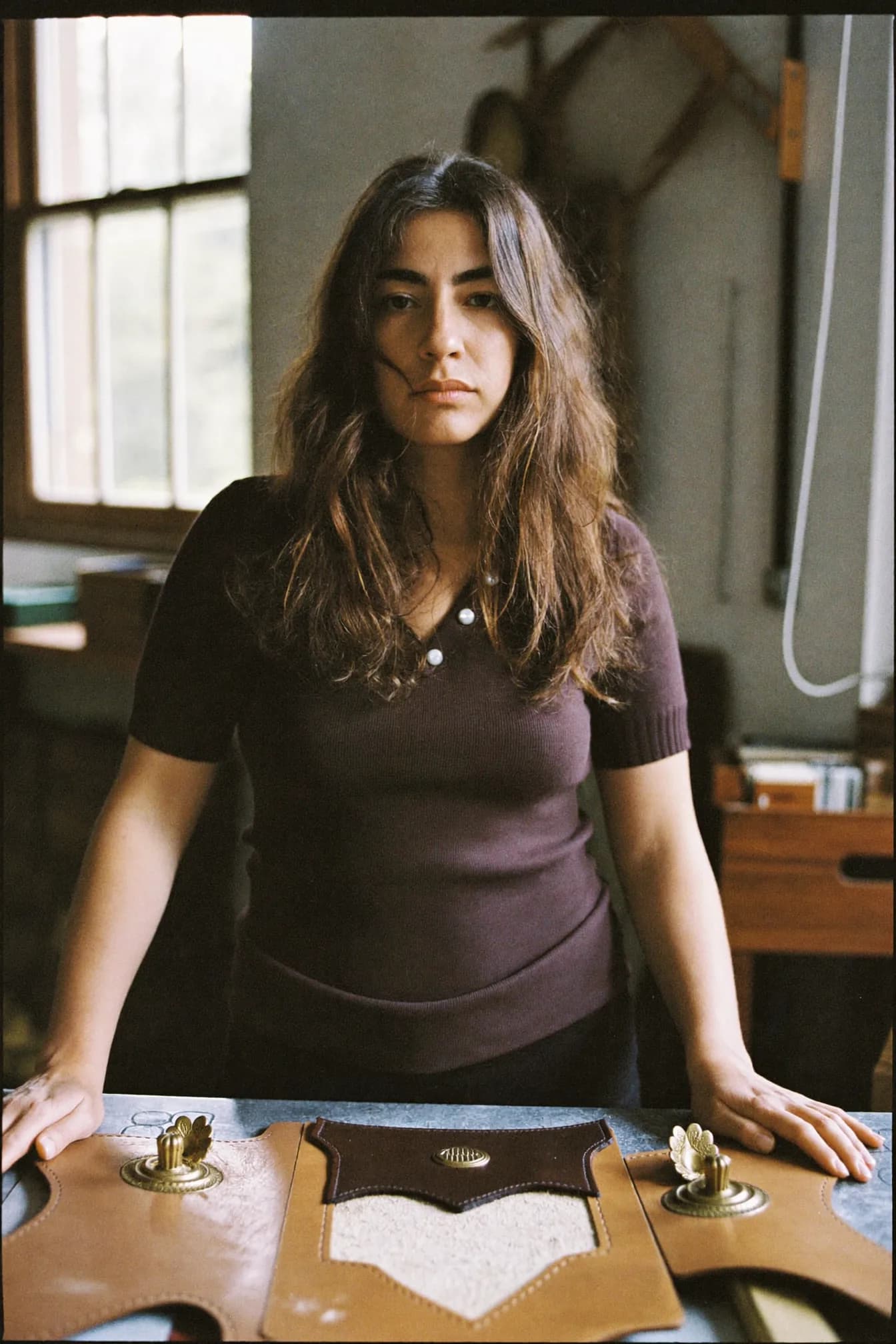
The dies are still in the drawer. Eleven of them, steel, each one shaped to a part of a wallet that Inês Carvalho no longer makes — cut to a specification she did not write, for a customer whose name she is content to leave out of this. They cost about €400 each and they are, in the strict sense, worthless. She keeps them in the second drawer of the bench, where she can see them when she is looking for something else. “I could sell them for scrap,” she says. “I prefer the reminder.”
Carvalho makes small leather goods — belts, wallets, a card case that has been the same shape for nine years — in a workshop with six benches and, at the moment, five people at them. In 2022 a single wholesale account was 60% of her revenue. In 2023 she ended it, in an email that took her four days to write and about nine seconds to read.
How it happens
Nobody sets out to become a contract factory. Carvalho’s version began the way most do, as good news: a buyer with a real order, paying on 30 days, at a volume that let her stop worrying about January. The first year was the best year the workshop had had. She hired two people. She bought a splitter she had wanted for four years and named it, which she says now was the tell — you do not name a machine you are about to be told what to do with.
The erosion was not a decision. It was a sequence of reasonable requests, each of which she granted because each of which was small. Could the stitch be tonal rather than contrast, for their customer. Could the edge be painted rather than burnished, which is faster, which she agreed with. Could she hold four weeks of finished stock at her cost, since their warehouse was tight. Could she move the card case’s corner radius two millimetres. Could she stop putting her stamp on the inside, since it confused people.
Not one of those was worth a fight. That is the design of the thing. You never get one request worth a fight — you get forty that aren’t, and at the end you are a factory with somebody else’s name on the product and your own name on the lease.
The stamp was the one that woke her. She agreed to it, on a Tuesday, in about a minute, and then sat in the workshop after everyone had gone and worked out that she had just consented to make an anonymous product. She was 34, she had a splitter with a name, and she had spent the previous eleven months making a wallet she thought was slightly worse than the one she used to make, at a margin of about 19%, for a buyer who had begun using the word “our” about it.
The arithmetic of leaving
She did not leave immediately, which she says is the part founders skip when they tell this story at conferences. She spent nine months preparing, because 60% is not a number you walk away from on a feeling. What she found when she opened the books properly was worse than she expected and, oddly, made it easier:
- 60% of revenue. 78% of her own working hours, once she counted the calls, the stock counts and the sample rounds.
- Gross margin of 19%, against 54% on the pieces she sold direct.
- Payment terms that had drifted from 30 days to 52 by actual behaviour, which she had never once escalated.
- Four weeks of finished stock held at her cost — roughly €31,000 of leather sitting on her shelves under their forecast.
- Direct customers: 240 at the start of the account, 190 at the end. She had stopped selling to the people who paid her the most, because she had no afternoons.
That last line is the one she puts in front of anyone who asks her advice. The account had not merely occupied the workshop. It had quietly been eating the thing that would have replaced it. She had assumed her direct business was a stable base she could return to. It was not a base. It was a garden she had not watered in two years.
The two bad years
The email went in March 2023, with six months’ notice, which she offered and they declined; they took four weeks and left. Revenue fell 58% and stayed there for most of a year. She let two people go — the hardest thing she has done and the one she refuses to characterise as anything other than a failure of her own planning — and rebuilt from 190 direct customers by doing, she says, nothing clever whatsoever. She wrote to all of them by hand. She reopened the Saturday workshop tours she had cancelled in 2021. She put the stamp back on the inside of the card case and, in the first month, three people wrote to say they had noticed.
The workshop passed its old revenue in late 2025 with five people instead of seven, at a gross margin she describes as “the correct one,” and with no customer above 9% of the book — a ceiling she now enforces, and which cost her a €190,000 order last spring. She says she thought about that one for a weekend. The Sherwood Index reckons roughly a third of small manufacturers have a single account over half their revenue, which Carvalho finds unsurprising and mildly frightening, because she knows exactly how pleasant the first year of that is. The dies stay in the drawer.