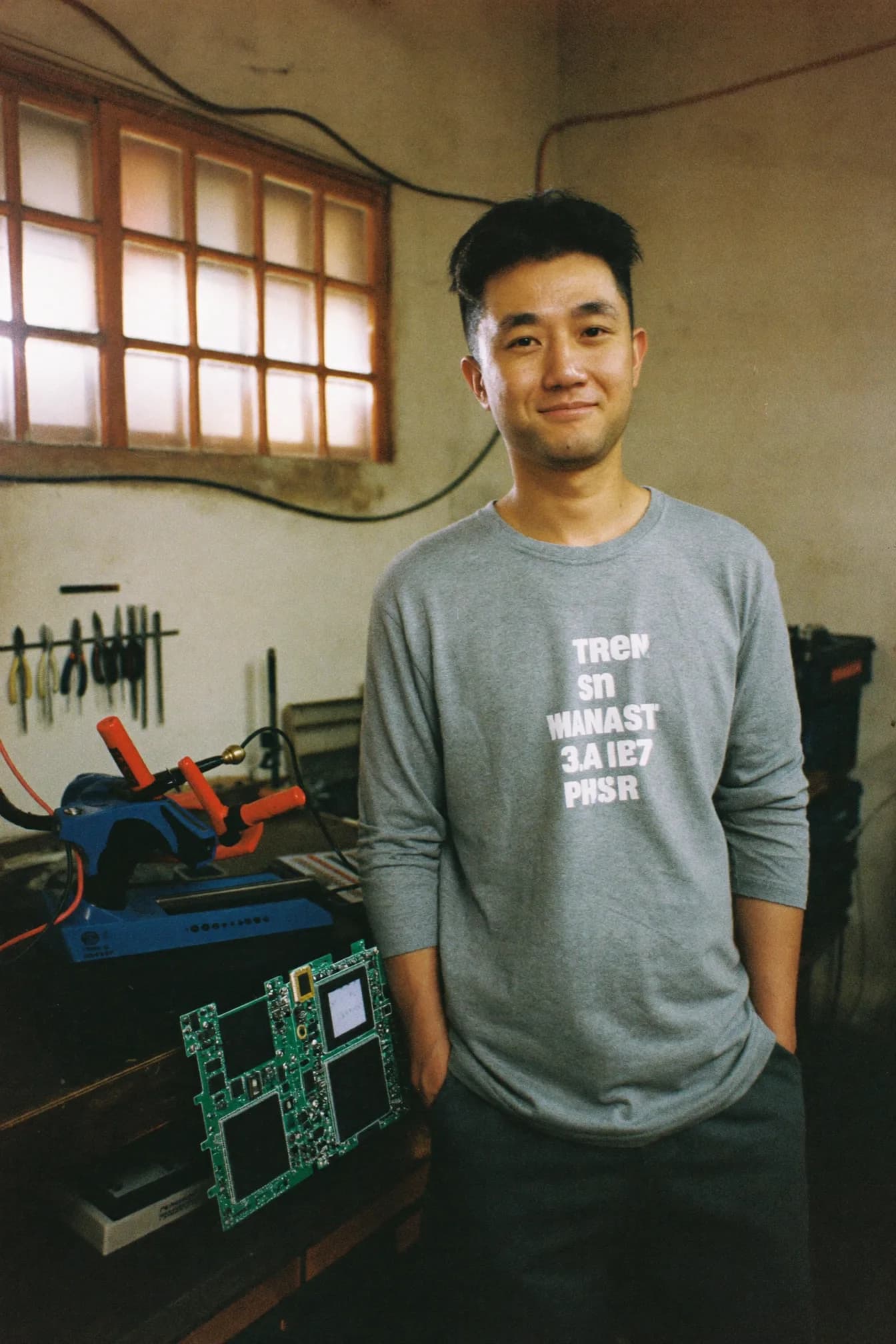
The first prototype is on the shelf above Joon Park’s bench and it is, he says with some pride, hideous. A circuit board, a sensor, and a housing he milled out of a solid block of aluminium over two evenings, which is why it weighs about four times what it should and has a corner he sanded flat after dropping it. It works. It has always worked. Getting five hundred of them made took him nineteen months, and none of that time was spent on the part that works.
Park makes hand-held light meters — the small instrument a film photographer points at a scene to be told what the camera should do. Wren Instruments sells about 900 a year at $340 each, direct, to people who already know they want one. The market is not large and Park is precise about this: he estimates there are perhaps 40,000 people on earth who would ever buy his product, and he is delighted by that number, because it is 40,000 more than zero and no serious company wants it.
That last fact is the whole story of his first two years.
Eleven noes
He counted them, because he is an engineer and counting is what he does instead of despairing. Eleven factories, over fourteen months, and he can characterise the noes by type. Four never replied. Three replied with a minimum order quantity of 10,000 units, which at his bill of materials was about $780,000 of stock for a market of 40,000 people. Two quoted him tooling — $60,000 for an injection mould, amortised over a run he would never place. One agreed, took a deposit, went quiet for five months, and returned the deposit, which Park says makes them the second-best of the eleven. The eleventh explained why, at some length, and that one changed everything.
The explanation was simple and Park had never once considered it. A factory’s scarce resource is not machine time. It is changeover — the hours spent stopping a line, swapping tooling, re-running first articles, and getting a process back into tolerance. A run of 500 costs almost exactly as much changeover as a run of 50,000 and pays for none of it. Park had spent fourteen months asking people to lose money as a favour, and then reading their politeness as a market signal.
I kept asking, would you make five hundred of my thing. Every one of them said no, and every one of them was right. It was a bad question. It took me a year to notice I was getting a correct answer.
The better question
The question he asked the twelfth factory was: what do you already run on a Tuesday? Not what can you make. What is already set up, in tolerance, and running — and what would I have to change about my design to be part of it?
The answer was an anodized aluminium extrusion, in three lengths, that the shop produced continuously for an industrial customer with a standing order. Park redesigned the housing around a profile he did not choose, in a wall thickness he did not choose, with an internal channel he had no use for and has never removed. His enclosure is now somebody else’s enclosure, cut to a different length. The tooling cost him nothing, because the tooling already existed and was already paid for by a company that will never know his product exists.
What he gave up, he lists without visible pain:
- The shape. The meter is a rounded rectangle because the extrusion is. His sketches were not.
- Two millimetres of wall thickness he does not need, which is about 40 grams of aluminium he pays for on every unit.
- The corner radius, the colour options — three, all anodizing the shop already ran — and the ability to change any of it without a conversation.
- A vestigial channel down the inside of the housing, which does nothing, which he has stopped explaining to people.
- Schedule control. Wren is built in the gaps, so his run happens when the line has a gap, and a gap is not a date.
What he got was 500 units at a landed cost that let him price at $340 with a real margin, with no tooling bill and no inventory he had to pre-buy. He now runs 300 at a time, three times a year, and the shop has never asked him for a minimum, because he is not a customer in the way the 10,000-unit people are a customer. He is filler. Park uses the word cheerfully. Filler is a wonderful thing to be, he says, if you can live with somebody else’s Tuesday.
What he tells people now
The Brackett Group, in a survey of small-run hardware founders last year, found that the median respondent had approached nine manufacturers before placing a first order, and that a bit over a third never placed one at all — they abandoned the product, not the design. Park read this and recognised himself somewhere around month ten, when he had begun quietly redefining the project as a hobby so that failing at it would hurt less.
His advice, when photographers email him wanting to make a thing, is not encouragement. It is a reordering. Design the product last, he tells them. Go and find what is already running, in a shop within driving distance, and find out what it would cost that shop to let you ride along. Then draw your product inside the shape of the answer. It is, he admits, an ugly way to design something. He gestures at the milled prototype on the shelf — the beautiful one, the one that is exactly what he wanted, the one that exists five hundred times fewer than the compromise.