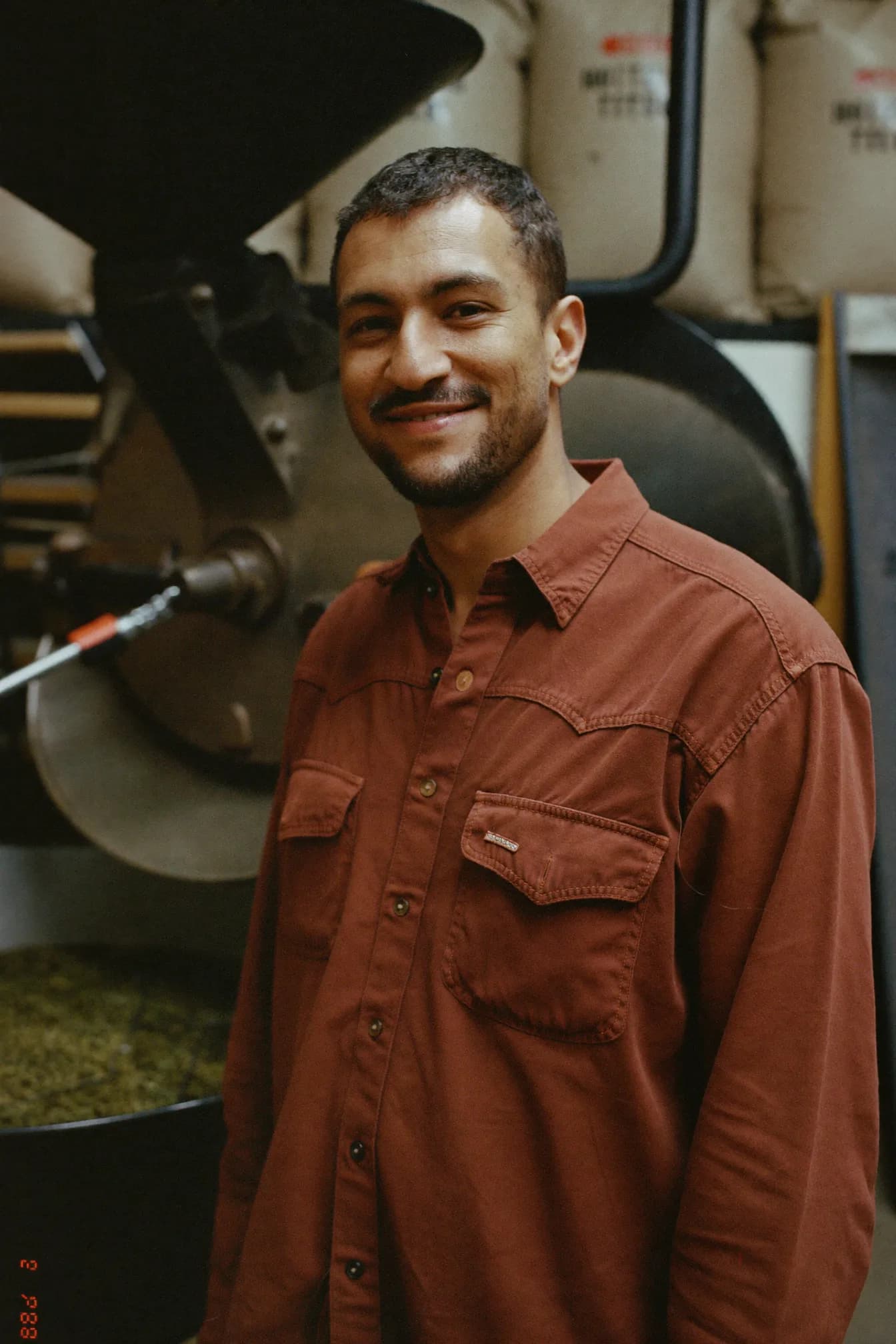
The van had 240,000 miles on it and a passenger seat Marcus Reeve had stopped apologising for. At ten past five in the morning he would put twelve kilos of coffee in the back, drive to a café that had not ordered it, carry it in, and then — this was the part that mattered, and the part nobody understood — stay. Not to sell. To stand near the machine with his hands behind his back for forty minutes while a barista who had not been warned about him made drinks for people going to work.
He did this for a year. Fourteen cafés, about 4,100 kilos, roughly $47,000 of coffee at what he would have charged for it, none of it invoiced. He was 31, he had a used drum roaster in a unit with a roller door, and the money came from selling a flat he had inherited, which he says is a detail he includes because leaving it out would make the story a lie.
“Everyone thinks free is a discount,” he says. “It isn’t. A discount buys you an order. Free bought me a chair in the corner of fourteen kitchens for a year. I could not have purchased that. It was not for sale at any price, and I know because I tried to buy it first.”
What he thought he was learning
Reeve went in believing he was running a taste experiment. He had eleven roast profiles and a theory about each. He expected the cafés to tell him which coffee was best, and he had built a form for it, which he now describes as the single most embarrassing object he has ever laminated.
Nobody filled in the form. In four months he got two back, both from the same person, both saying “great, thanks.” What he got instead, by standing there, was the discovery that the coffee was not the problem and had never been the problem. It was fine. All of it was fine. The problem was that every time a new bag arrived — his or anyone’s — the barista lost twenty minutes at six in the morning re-dialling the espresso, throwing away two or three shots at a time, because the roast had moved.
I watched a nineteen-year-old bin eleven shots before the queue arrived, and she wasn’t angry about it. That was the horrifying part. She thought that was the job. Every roaster she’d ever had did that to her.
So the product changed, in the eighth month, from a coffee to a promise: the same coffee. Reeve stopped chasing the best possible roast and started chasing the smallest possible variance, which is a duller ambition and a much harder one. He blends across three origins now specifically so that one crop failing does not move the cup. He publishes a dial-in card with each bag — grind, dose, time, the two numbers that changed since last delivery — and if the card is wrong he replaces the bag, which has happened nine times in four years and cost him about $700 and, he thinks, everything.
The ledger of a free year
He is not romantic about it, and answers the cost question fast:
- $47,000 of coffee, plus a year of his labour, plus a van that did not survive.
- Three of the fourteen cafés never opened the bags. Free does not create obligation; it removes it.
- Two took the coffee for the entire year and then signed with someone cheaper, which Reeve says was fair and which he understood, eventually, in about April.
- One told him, in month three, that his coffee was worse than what they had. This was the most valuable conversation of the year and it lasted four minutes.
- Nine of the fourteen became paying customers. Seven still are.
The nine converted for a reason Reeve did not engineer and now considers the whole mechanism. He had been in the kitchen. He knew the machine, the grinder, the thing wrong with the water, the name of the person on the morning shift. When he finally sent an invoice, in month thirteen, the owners were not evaluating a supplier. They were being asked whether they wanted the man who fixed their Tuesday problem to keep coming, and the coffee was almost incidental to the answer.
The part that doesn’t transfer
Reeve now roasts about 39 tonnes a year for 61 wholesale accounts, with six people and a roaster that is not used. He is asked about the free year constantly, usually by founders wanting permission to give something away, and he says he mostly tells them not to. The free year worked because the thing he needed was not attention or trial or a logo on a page. It was forty minutes of unguarded observation of a process he could not otherwise see, and free was the only currency that bought it. If what you need is customers, he says, free will get you people who like free.
The Sherwood Index puts churn among specialty wholesale accounts at about 34% a year. Reeve’s is 7%, which he attributes not to loyalty — he thinks loyalty in this trade is a story roasters tell each other — but to the cost of switching, which he has deliberately made high by being the supplier who does not force the six a.m. re-dial. He still does one morning a week in somebody’s kitchen, hands behind his back, saying nothing. His operations lead has suggested this is no longer a good use of his time. Reeve says he has heard the argument and finds it persuasive, and then goes anyway.