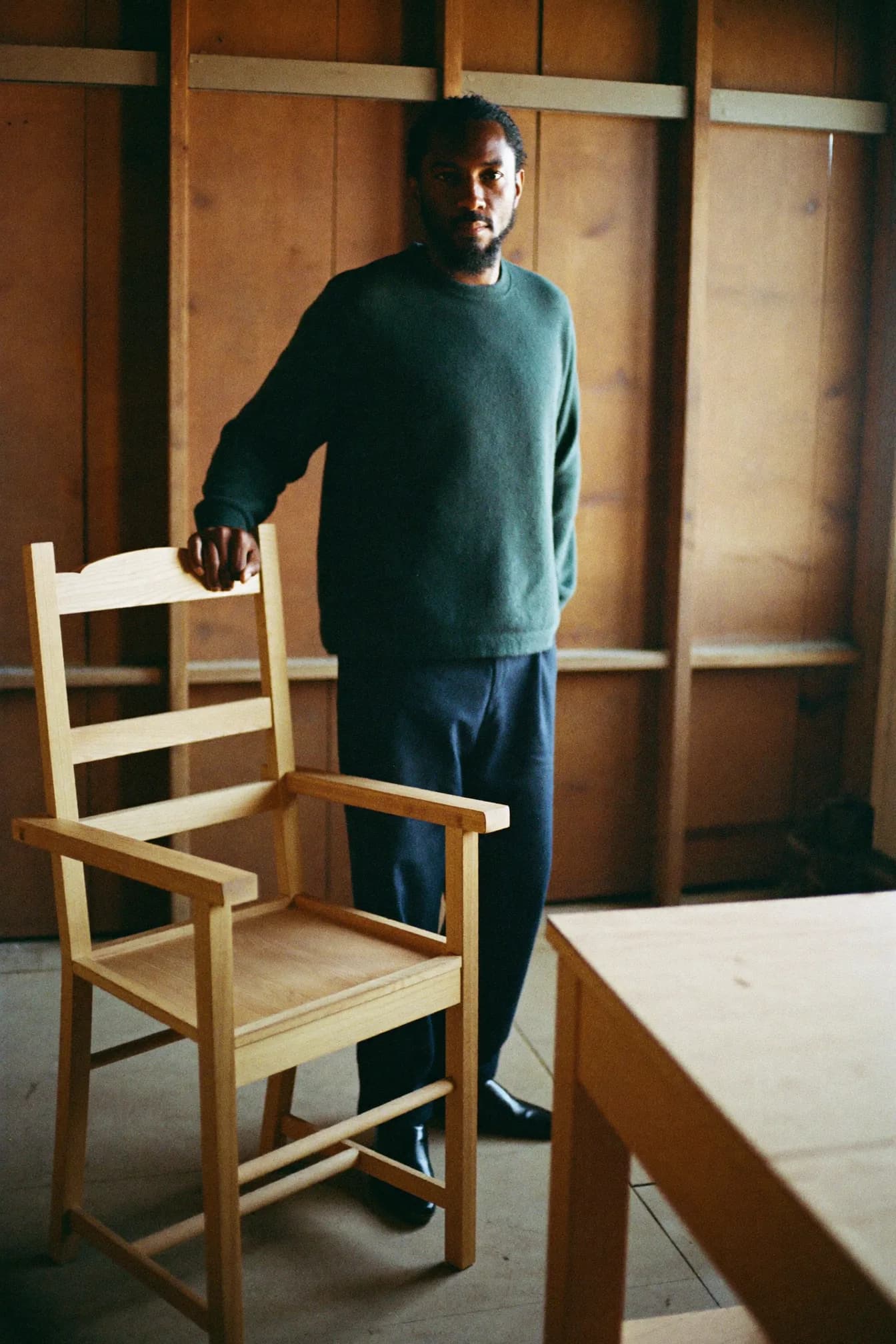
The oak in the yard behind the grain store has been there for four years and will be there for two more. It is stacked in the way timber has always been stacked, boards separated by thin battens so the air can get at them, under a roof Martin Oduya built himself in Brackwood’s third year because he had no money to rent one. He puts a hand flat on the top board the way you would on a dog. Six years of a company’s working capital, lying in a yard, doing nothing that shows up on a spreadsheet. “People think this is the romantic part,” he says. “It’s the balance sheet.”
Brackwood makes dining chairs and the tables that go with them. It has twenty employees, a fourteen-month waiting list, and eleven years of history. Oduya has spent a good portion of those eleven years explaining the first two numbers in terms of the third, usually to people who came to the workshop expecting a story about craft and left having had a lecture about capacity.
Ask him whether the slowness was a choice or a symptom, and he corrects the question before answering it. “It’s a choice that looks like a symptom for about eight years,” he says. “Then it stops looking like one, and everybody decides you were wise. I wasn’t wise. I was doing sums.”
The sum
Here is the sum. A Brackwood maker takes about six years to work the full chair alone. The workshop can carry two apprentices at a time — not for reasons of money or bench space, but because supervision is done by the senior makers, and a senior maker who is teaching is producing at roughly half rate. Two apprentices at a time, six years each, eleven years elapsed: twenty people. The growth rate everyone finds so disappointing is not a growth rate at all. It is a teaching rate with a business attached.
Oduya has run the counterfactual, because he is not a man who declines to run counterfactuals. If Brackwood had taken the retailer’s 400-chair programme in year four, the workshop would have needed about nine additional makers inside eighteen months. It could have trained one and a half in that time. The other seven and a half would have arrived from somewhere else, already formed, and the eleven days a chair takes would have become six, because that is what the price required.
You cannot hire the six years. That’s it. That’s the entire strategy, and it took me a decade to be able to say it in one sentence.
The distinction he keeps returning to is between growing and adding. Adding is easy and he could do it next month. Growing means the thing that comes out the other end is still a Brackwood chair, and the only mechanism he has ever found for that is a person who has been standing next to another person for six years. He does not think this is noble. He thinks it is a bottleneck, and he says the interesting decision of his career was declining to route around it — five times, by his count, each time for money he can still recite.
What twenty is
Twenty is not a target. It is the number Brackwood can carry through a bad year without asking anyone to leave, and Oduya has tested it twice — once in year six, once more recently — which is how he knows it is twenty and not twenty-six. Both times the order book fell by roughly a third and both times nobody went. The second time, he says, he knew by the second month that it would hold, and the relief was so total that he went out to the yard and sat down.
He is unsentimental about why this matters commercially rather than morally. A workshop that lays off makers in a downturn is a workshop that has thrown away four years of training and will spend six getting it back, at exactly the moment it has no money to spend. The lay-off is not a cost saving. It is a liquidation of the only asset the company has, at the bottom of the market, and Oduya says he has watched three workshops do it and none of them came back the same.
- Turnover last year: £2.4M, on a margin Oduya describes as “adequate and boring.”
- Debt: none, ever, beyond a van. He is aware this is unfashionable and does not wish to discuss it.
- Waiting list: fourteen months, tried and failed to cure four times, including a price rise in 2023 that made it longer.
- Apprentices who left before finishing: three. He keeps their names in a notebook.
- Years he paid himself less than his senior makers: six of eleven.
The part he concedes
The Brackett Group, which studies small manufacturers, published a note last year arguing that workshops of Brackwood’s type are structurally capped at around thirty people, and that most of them mistake the cap for a philosophy. Oduya read it and says the honest answer is that he cannot prove he isn’t doing exactly that. What he can say is that he tested the cap on purpose rather than discovering it by accident, which he thinks is the only difference between a strategy and a rationalisation, and a thinner difference than he would like.
The cost lands on the apprentices, and he knows it. Six years is a long thing to ask of a twenty-four-year-old on the strength of a promise he cannot actually make. He tells them at the start that he can’t guarantee the workshop will want them at the end — only that it never yet hasn’t. Then he goes back to the bench. Out in the yard the oak keeps not doing anything, which is the point of it, and will keep not doing anything for two more years, by which time the maker who cuts it will be halfway trained.