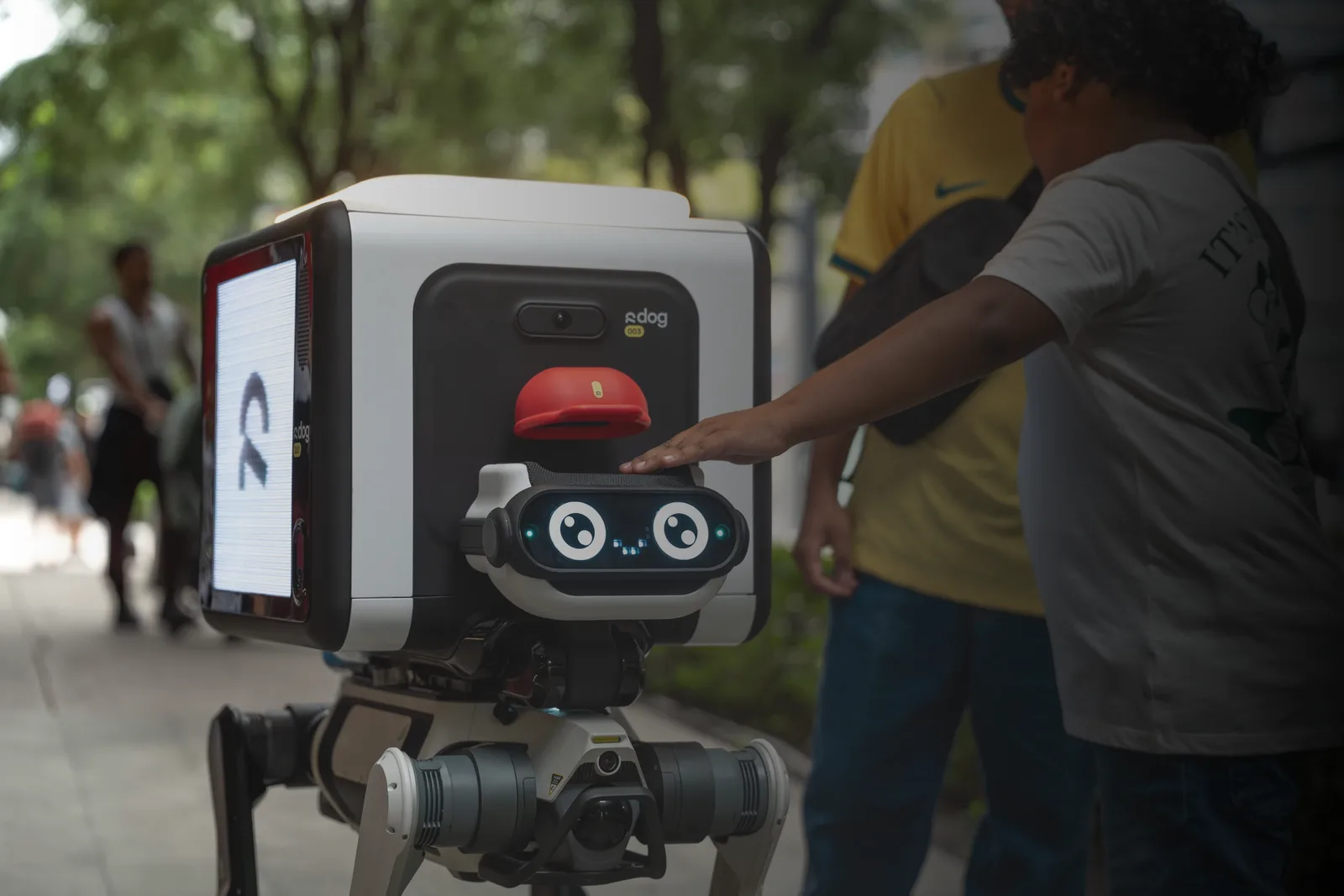
Every delivery robot has the same enemy, and it isn’t traffic or weather. It’s a staircase. For the better part of a decade, Robot.com has been putting machines to work in the real world — campus delivery first, back in 2017, then wider — and across all those deployments one problem refused to go away. David Rodriguez, the company’s co-founder, calls it the last hundred meters. A wheeled robot is excellent on a sidewalk and helpless at a curb; the moment it meets a step or an uneven threshold, the trip ends and a person has to finish it by hand.
R-dog is the company’s answer to that gap. It is a delivery robot with four legs, each ending in a wheel, so it can roll across flat ground and still handle the obstacles that, by Rodriguez’s account, stop every other delivery robot on the market. Robot.com announced it as a concept on August 11, 2026, naming the robotics firm Field AI as a co-development partner on its autonomy stack. It is the newest shape in a fleet the company has been building for years.
The platform under the legs
What sets R-dog apart is as much software as hardware. The robot runs on REMI, Robot.com’s fleet-management platform — the same operational intelligence that, by Rodriguez’s account, already runs hundreds of robots across campuses, warehouses and cities. Building on that shared foundation, he says, is what lets the company field a new form factor like R-dog without rebuilding from scratch.
The second difference is money. Each R-dog will carry dual screens and run R-ads, the company’s advertising platform — turning the robot, in Rodriguez’s words, into “a moving media platform and opportunity where brands can run campaigns on its dual screens while it makes deliveries.” The argument is that advertising isn’t a bolt-on but part of the unit economics: revenue earned on a route the robot was already running.
No other delivery robot combines last-mile capability, emotional design that makes people want to interact with it, and an advertising layer that improves the unit economics on every route.
Two stages, one week
The turning point, Rodriguez says, came in June, and it came twice in the same week. On June 22, 2026, the company launched R-noid — a humanoid robot built for the repetitive, multi-shift, hard-to-staff roles that operators in food service, logistics and industrial settings chronically can’t fill — at the Automate show in Chicago. That same week, Robot.com was in Cannes as the official Robotics Innovation Partner for PMG’s AI & Tech Sandbox, running a live fleet in front of the agency CEOs, CMOs and brand leaders who decide where advertising budgets go.
Two major stages, same week, two different product stories pointing to the same platform.
On the campus side, on August 20, 2026, the company announced a seven-year agreement that expands its partnership with Sodexo — evidence, Rodriguez says, that “the model doesn’t just work — it scales.”
Who it’s for
The immediate customer is the operator: campus dining programs, urban delivery partners, and brand marketers looking for new ways to reach people in physical space. But the response since the R-dog announcement, Rodriguez says, has been wider than that — reporters, investors and brand partners reaching out — because the fleet sits where three current preoccupations meet: physical AI, the future of last-mile delivery, and out-of-home advertising “that actually works.”
A concept, on a foundation that isn’t
R-dog is still a concept. Commercial deployments are targeted for 2027, and college campuses are expected to go first — geofenced environments where Robot.com already has years of operational experience to lean on. Until then the work is refining the platform, finalizing specifications and continuing the Field AI collaboration on the autonomy side.
R-dog is a concept today, but the foundation it’s built on is already running at enterprise scale.
The bet underneath all of it is a plain one: the hardest part of delivery was never the long haul. It was the last hundred meters — and Robot.com is wagering that four legs, each ending in a wheel, and a platform it has spent years building, are what finally close it.