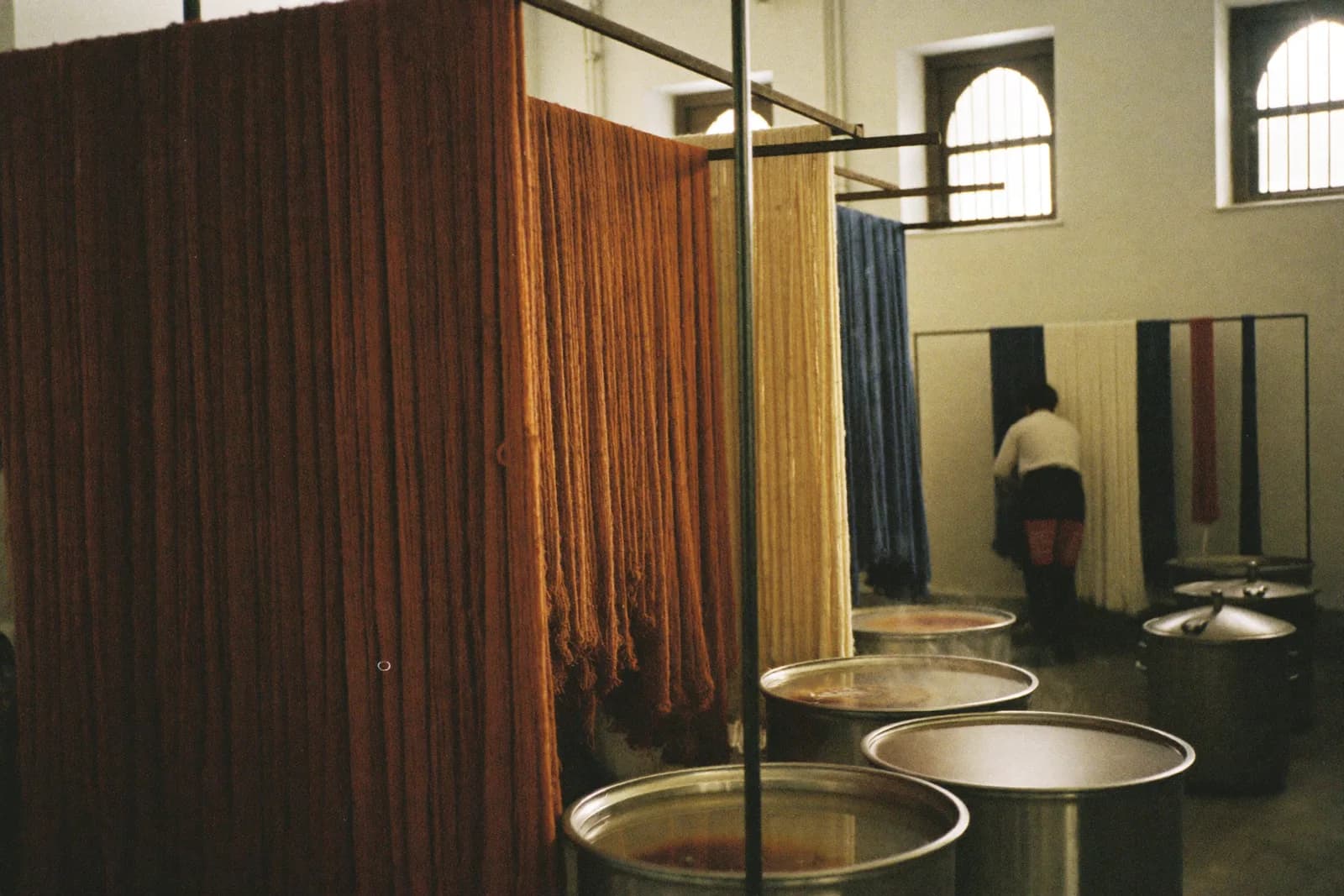
There is a whiteboard screwed to the wall of the dye house at Loom&Co with one number on it. Last Tuesday it said 6. It is the lead time in weeks, updated every Monday by whoever gets in first, and it is the only metric in the building that everybody knows without being told. When it reaches 9, something happens. It is not hiring, it is not a second shift, and it is not an apology email. The number goes up on the website instead.
Priya Nair’s company finished last year at $9.6 million with 34 employees and a gross margin of 61%, which is an unusual sentence to write about a business that makes blankets by hand. The margin is not the result of clever sourcing or a manufacturing insight. It is the residue of a rule Nair wrote down in 2019 and has never once let anyone override: a queue means the price is wrong, not that the factory is small.
The rule as an operating system
Most companies treat price as an outcome — costs plus a bit, or whatever the market bears, revisited annually by someone with a spreadsheet. At Loom&Co it is the control surface. Demand exceeds capacity, so price rises until it doesn’t. That is the entire mechanism, and its consequence is that Loom&Co has never had a capacity conversation, because capacity is not the variable being solved for.
The history is legible on the price list. After the 2019 doubling, the wide blanket went to $960 in 2021, $1,080 in 2023, and stayed there through 2024 — a year in which cotton moved and the price didn’t, because the board said 5 all summer. It went to $1,180 last spring, when the board hit 9 in April and held there for a fortnight. Hana Ferrell, who runs operations, points out that this makes the pricing look erratic to anyone reading it as a cost pass-through and perfectly regular to anyone reading the whiteboard. It also settles who the customer is, over and over, without anyone holding a positioning workshop: every rise sheds the people at the margin. Nair says the customer base has changed more in seven years than the product has, and that she has never once done it on purpose.
Hiring to clear a queue is borrowing against a demand curve you haven’t measured. Raising the price measures it, for free, in about a week, and if you’re wrong you can put it back.
The one thing she bought instead
The exception is the dye house, and it is the exception that shows what the rule is actually for. Loom&Co dyed through a contractor until 2022. The work was competent. The problem was that the contractor could not repeat a colour — a rust in March and a rust in September were two rusts, close enough for anyone except the customer who had ordered a second blanket to match the first, which turned out to be a fifth of the order book. Nair spent $1.4M she did not really have on vats, water treatment and a chemist named Iyad Sarraf, and spent 2022 losing money for the first time since the doubling.
She is precise about why this did not violate the rule. The queue was not the problem; the colour was. The dye house was not bought to make more things faster. It was bought so that the thing being sold was a different thing — a colour with a name and a formula that would still exist in 2031. Nine points of the 61% margin came out of that building, but Nair maintains the margin is a side effect. What she actually bought was the ability to say yes to the second blanket, which is where the money in textiles has always been and which the contractor structurally could not sell her.
What the rule costs
It costs real revenue, visibly, and Nair has stopped pretending it is painless. The department-store programme she turned down last year was $2.4M annually on a three-year commitment. Taking it meant a second dye house, roughly eighteen new people, and a price the buyer had already set — which is the actual objection, and the only one Nair raises unprompted. The programme was not a queue she could price her way out of. It was somebody else’s pricing power arriving with a purchase order attached.
The other costs are quieter and add up:
- Nine wholesale accounts left in 2019 and Loom&Co has added four in seven years. The company has no meaningful distribution and never will.
- Growth is lumpy and unforecastable, which makes the business roughly unfinanceable. No bank has understood the whiteboard. Nair has stopped explaining it.
- The company is 34 people and has been within four of that number since 2023. Two people have left because there was nowhere to be promoted to.
- It only works while the work is good. Nair calls this the rule’s hidden clause — the day the blanket is ordinary, the price is a lie and the queue never comes back.
The 1974 Macomber sits in the corner of the main floor, four harnesses, and Nair still works it herself. Ferrell has called it the company’s only sentimental line item, in Nair’s hearing, and Nair does not entirely dispute it — but she has a defence, and it is characteristically about price. Sitting at the loom is the only way she knows how long a thing takes. She threw the shuttle for the current sample run for two hours on Monday. The board said 6. She would like it to say 9.