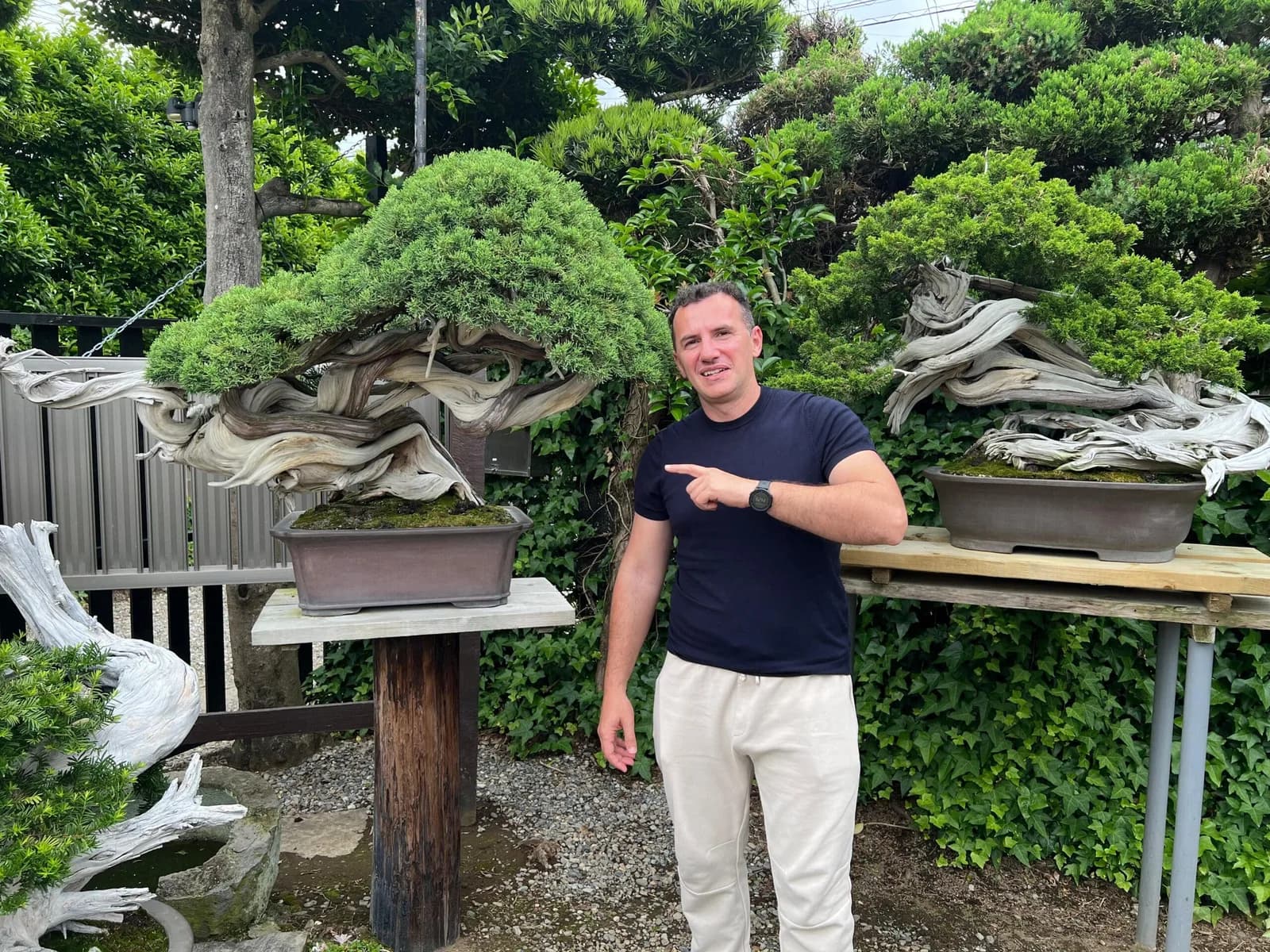
Almost every instinct in modern business favours speed: ship early, grow fast, replace what breaks. Roberto Liccardo sells a product that punishes all three. A branch takes years to reach the position he wants it in. A trunk earns its character slowly. A decision made this spring may not show its result until three summers from now. From a nursery in Calabria, in the deep south of Italy, he has built a company on the one quality the rest of the economy is organised against.
The company is WeBonsai, and it is an unusual hybrid: part specialist nursery, part European retailer, part school. Liccardo, who has more than twenty years of practice behind him, describes the art in terms that explain the business better than any strategy document. “Bonsai is not gardening,” he writes on the company’s site. “It is sculpture that breathes.”
The phrase is doing real work. A sculpture is finished; a bonsai never is. It keeps growing, keeps responding to light and water and season, and it will answer every decision its owner makes — including the careless ones. That is the product. It is also the problem.
Selling something that is still alive
Most retail assumes an identical unit. Bonsai refuses. Two trees of the same species will differ in trunk, root, age, history and temperament, so quality control begins years before anything is sold. The inventory grows, changes, gets sick, and occasionally becomes unavailable because a tree is simply not ready.
Liccardo’s sourcing tells you what standard he is holding to. He has travelled to Japan to buy trees directly — “not from wholesalers,” as he puts it, “but from the growers and masters who shape them over years.” Each tree he brings back is chosen by hand for structure, age and character. His stated test is not commercial: “If it doesn’t move me, it doesn’t come home.”
Then it has to survive the post. Shipping a tree is not shipping a box: there are brittle branches, live roots, and soil that has to stay where it was put. WeBonsai says its trees go out in wooden crates, “each one photographed, crated, and shipped by hand.” The nursery in Calabria is where they are grown, selected, photographed, packed and sent, and from there they go to customers across Europe.
The sale is not the finish line
Here is the commercial trap the bonsai trade sets for itself: a successful sale does not produce a successful customer. Someone buys a healthy tree, and six weeks later the leaves yellow. They don’t know whether that is thirst, position, the wrong soil, or simply autumn doing what autumn does. The tree dies, and the conclusion the customer reaches is not “I made a fixable mistake.” It is “this is beyond me.” The trade then loses that person permanently.
So WeBonsai is built to answer the question the tree provokes. Its site runs a beginner’s path — “step by step, from choosing a tree to shaping it” — alongside a seasonal calendar that tells an owner what the tree needs this month, a species library, and a diagnostic tool that, in the company’s words, asks “a few simple questions and we’ll help you find the cause.” Every tree ships with plain-language care notes for its species.
The support is deliberately human. The company offers help over WhatsApp and promises that “a real person answers — usually within the hour.” In a market drifting toward automated service, a founder with twenty years of practice answering messages himself is a strange use of expensive time. It is also the whole proposition: the buyer is not purchasing a plant so much as access to the judgement that produced it.
If it doesn’t move me, it doesn’t come home.
A nursery that reaches four countries
The digital half of the business is what lets a specialist nursery in Catanzaro behave like a European one. The site runs in English, Italian, French and German, which is a deliberately narrow, deliberately serious bet: four languages, chosen markets, no attempt to be everywhere.
The teaching is not a marketing layer bolted onto a shop — it is what makes the shop work at that distance. Written guidance stands in for the conversation that would otherwise happen across a bench in Calabria. It also does something a catalogue cannot: it demonstrates competence. Anyone can photograph a tree well. Explaining why a particular branch should go where it is going, to a beginner in Germany, in their own language, is harder to fake.
That has a commercial logic too, though it takes years to pay. Someone who begins with one modest tree and does not kill it tends to come back — for a better specimen, a handmade pot, the proper tools. Education is not charity here. It is customer development on the timescale of the product.
The part that cannot be shipped
Some of it, though, refuses to travel. WeBonsai runs hands-on workshops and residential bonsai retreats in Calabria, sold through operators including GetYourGuide, with programmes that run from a few days to a fortnight and fold in accommodation, meals and excursions alongside instruction in selection, pruning, wiring and shaping.
This is where the location stops being an accident of biography. Calabria is not merely where the company happens to be; its light, climate and slower rhythm are the lesson. And there are things no species library can transmit — the pressure of the hand when wiring, the angle a branch reads from three steps back, the immediate correction of a teacher watching you get it wrong.
Which is the argument the whole company makes, in the end. WeBonsai has taken a craft that resists scale, industrialisation and haste, and used ordinary modern tools — a shop, four languages, a WhatsApp thread — to widen the door without cheapening what is behind it. The trees still take years. That was never the inefficiency to be engineered away. It was the product.
Sources